Laylah Amatullah Barryn Won A Brooklyn Arts Award
Laylah Amatullah Barrayn Won A Brooklyn Arts Award By Helping Us See Others
- Barryn uses photography to capture the beauty and dignity of everyday Black life, rejecting objectivity.
- Barryn sees her work as crucial in an era of digital disruption, preserving collective memory and history.
- Barryn embraces the subjectivity of photography, seeing it as a tool to expand the reach of contemporary art.
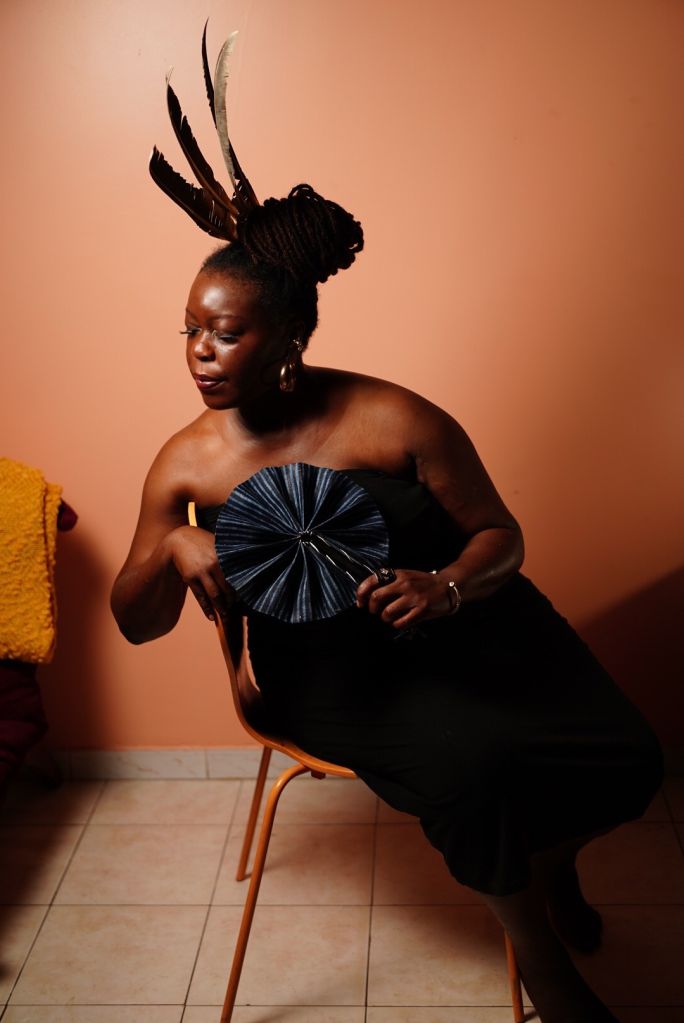
If you have ever fallen asleep waiting on your mother in an office chair or watched your daughter rush into her arms at pick-up time, artist Laylah Amatullah Barrayn sees you.
She earned a Brooklyn Arts Award this year for her unique perspective. Amatullah Barrayn earned that honor by accepting the limitations of objectivity and expanding the practice of storytelling in her photography.
“I want people to understand how important it is to remember and to document to not forget who we are, and our community and immediate surroundings, which is the beauty of photography,” Amatullah Barrayn tells HelloBeautiful. “Photographers in general are interested in taking a step back and looking at the foundation of what this all means.”
What “all this” means to Amatullah Barrayn is clear. Her lens sees spirits. It celebrates sacrifices.
She romanticizes death rituals and infuses labor with dignity. She sees the sweetness in exhaustion and the hidden vibrance of monkdom. Her shots speak to the reality of collective memory. They preserve her views of institutions, relationships, and neighborhoods.
That contribution feels crucial at a time when digital Blackface, random avatars, and shifting algorithms obscure recent history. Some are deeply concerned about how widespread access to digital tools will affect the archival practice of photography.
On Framing The Future
“It’s been happening for a long time, pre-digital photographers like Richard Avedon and James Van Der Zee did very interesting things,” she points out. She sees today’s tools as tools, not threats. “There’s always been this kind of technology, that kind of pushed the boundaries of what we believe to be a recording, a truthful recording,” she continues. “When we look at a photograph, it is someone’s perspective.”
Related: Curator Dr. Ashley James Is In The Business Of Preserving Black Art
Every art form presents the questions AI is posing now, even if they haven’t always done so as loudly. “It’s someone’s edit, it’s someone’s view and gaze, so there’s a bit of augmentation there of reality,” she says. “When you point your frame, your camera, at someone or some place, you are now subtracting and deciding what’s going to go in the frame.”
Fighting Erasure
Her commitment to documenting helps correct a record that doesn’t always include everyone. Black media archives are disappearing, algorithms are deprioritizing content, and the definition of censorship is constantly expanding.
“As soon as we were brought to these shores, there was erasure almost immediately, the attempted erasure of identity names, customs, culture, memory,” says Amatullah Barrayn. “That is where my interest comes in and my urgency to document, and to remember, because I know how active erasure is.”
She describes the act of seeing as “writing with light.” That writing tells stories across continents.
Related: 10 Must-Know Black-Owned Art Galleries Shaping The Art World
Listening is a part of her process. She edits in a dark room listening to podcasts like Demetria Lucas’ Ratchet and Respectable. “That keeps me engaged. It keeps my brain going, my brain working, and also focuses me as well.”
Looking Beyond The Frame
Amatullah Barrayn grew up listening to Fab 5 Freddy. She will be honored next to him when she accepts the Brooklyn Arts Award. “It’s a pretty full circle moment,” she says. “It’s wonderful for our circles to overlap.”
There was a time when some might have felt hip-hop didn’t belong in formal arts institutions. Today, it gets recognized for what it is, an important art form. Music and other forms of pop culture have been infused into the kinds of places Amatullah Barrayn grew up visiting, like the Brooklyn Museum. Their First Saturdays programs set a standard for framing contemporary art as pop culture.
It expanded the reach of their exhibitions beyond the usual patrons, the way Megan Thee Stallion being on Broadway and Jeezy performing with an orchestra did.
Institutions like the The Newark Museum of Art, Atlanta’s High Museum, and Contemporary Arts Museum Houston have tapped into hip-hop culture in deep authentic ways. These kinds of cultural mashups lead to stronger arts communities.
“It’s interesting, because that’s what Fab Five Freddy did when he merged, all of these worlds back in the day,” says Amatullah Barrayn. “He really is responsible for a huge cultural shift in all of these intersections.”
Related: Tatianna Mack is Reclaiming Space In the Art World—One Story At A Time
Focusing The Lens On What’s Next
Amatullah Barrayn’s CV reads like a plump novella. She teaches at Rutgers and rejoices when she sees students’ curiosity rising.
Being a master doesn’t mean her technique is finished developing. She sees something new with every session.
“I’m looking to expand my own practice, my ways of being, my technical skill, my craft,” she says. “I’m growing, I’m learning, and so the journey continues.”
DON’T MISS:
Latoya Hobbs’ Poignant Portraits Celebrate The Simple Beauty Of Black Women’s Lives
Jewel Ham Paints The Dynamic Lives Of Black Women On Canvas
Laylah Amatullah Barrayn Won A Brooklyn Arts Award By Helping Us See Others was originally published on hellobeautiful.com