There Will Never Be Another Player Like LeBron James
There Will Never Be Another Basketball Player Like LeBron James
In 2003, George W. Bush was president. Gas was $1.59 a gallon, and a fresh-faced 18-year-old was about to make his NBA debut.
LeBron “King” James has been with us for 23 years, and we’ve spent so much time arguing about his legacy that we forgot to appreciate him.
Seriously.
For the better part of 23 years, sports television has been one endless loop of “Jordan would’ve never,” “LeBron isn’t clutch,” “He’s LeGM,” “He’s too political,” “He’s not political enough,” “Steph changed the game,” “Jokić is better,” “Luka is next.”
And somewhere between the GOAT debates, the memes, the barbershop arguments and the annual prediction that this would finally be the season LeBron fell off, we’ve missed the greatest act of all: LeBron James is still here.
Still starting, still getting points, still active in All-Star weekend.
Now, James is ready to move on from the Los Angeles Lakers, and the transaction itself almost feels secondary. Because this isn’t really about the Lakers. This is about something much sadder.
Father Time has been added to the group chat.
Don’t get me wrong, there are still NBA franchises that would give up half of their current roster to have James on their team (Looking at you, Washington Wizards). Because there are still nights when LeBron can rewind the clock and remind some 24-year-old superstar just who, in fact, he is. For over two decades, the man has been up 30 points in a game just as easily as if he were checking his email on his phone.
The problem isn’t that LeBron stopped being great. The problem is that his greatness no longer feels permanent. And that’s a feeling most basketball fans have never had to process.
Think about it.
There are folks reading this right now who don’t know the NBA without James. He entered the league when flip phones were still a thing. Before Twitter. Before Instagram. Before TikTok convinced everybody they were a basketball scout. Before streaming services, before NIL, before half the current NBA was old enough to spell “pick-and-roll.”
He has survived multiple commissioners, multiple presidents, multiple television deals, a pandemic, the rise and fall of superteams (which he may have started), the three-point revolution, load-management debates, and enough “next faces of the league” to fill a Hall of Fame wing.
Kevin Durant exploded. Stephen Curry changed basketball. Giannis Antetokounmpo conquered it. Nikola Jokić broke everybody’s understanding of what a center could be. Luka Dončić became the future.
And somehow LeBron just…stayed.
Every September, we’d convince ourselves that surely this had to be the year age caught him. Then April would roll around, and he’d still be doing things that made absolutely no sense for someone whose basketball age should qualify for AARP discounts.
At some point, we stopped treating longevity as extraordinary. We expected it. That’s on us. Because what LeBron has done isn’t normal. It’s not even close to normal. We’ve normalized insanity.
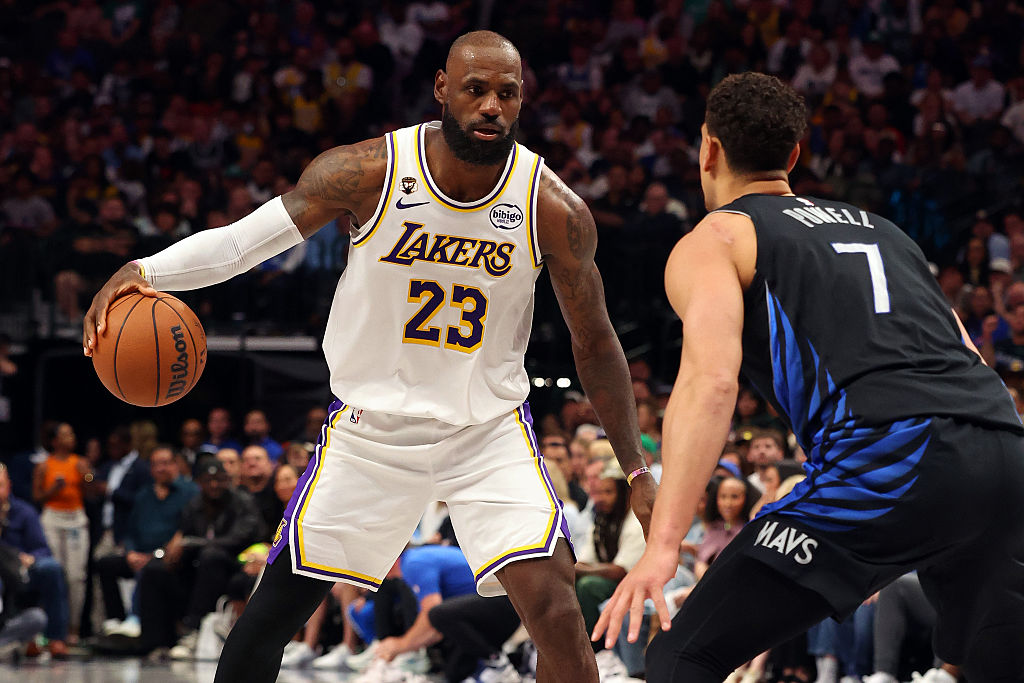
We’ve normalized a man entering his 40s averaging numbers that would make most franchises throw a parade if their franchise player posted them. We’ve normalized him chasing down players nearly two decades younger. We’ve normalized the idea that a 23-year NBA veteran should still be the smartest player on the floor and one of the best athletes in the building.
We’ve normalized impossible.
That’s why this latest move, leaving the Lakers after eight years with the team, feels different. Every decision LeBron makes now comes wrapped in something it never used to carry.
Finality.
Not retirement necessarily. Just…awareness. Awareness that this upcoming season could be the last truly great one. This could be his final playoff push. This could be his last nationally televised game.
Every rumor that James might be looking to form one more super team of extraordinarily old gentlemen reads like the plot of the next installment of The Expendables. But sports don’t tell you when to start grieving. They just quietly replace anticipation with nostalgia. Ask anybody old enough to remember watching Michael Jordan in a Washington Wizards jersey. The weirdest part wasn’t that Jordan looked older. It was realizing there would soon be an NBA where Michael Jordan wasn’t walking onto the court.
Kobe Bryant’s final years felt the same way. The injuries piled up. The body betrayed him. And then suddenly the conversation wasn’t about championships anymore. It was about saying goodbye.
LeBron has somehow delayed that feeling for nearly a decade longer than anyone thought possible. That’s why this hurts. Not because he’s leaving Los Angeles. Because leaving Los Angeles reminds us that there aren’t many exits left. And if we’re being honest, none of us are ready.
Love him or hate him, LeBron has been basketball’s main character since dial-up internet and MySpace were still a thing.
Think about how ridiculous that sentence sounds.
Kids who watched his high school games on ESPN are now sending their own kids to kindergarten. The teenagers who bought his first signature sneakers now have mortgages. Some of the players guarding him grew up watching YouTube highlights of his first stint in Cleveland.
LeBron has lasted so long that he’s become more than an athlete. He’s become part of the furniture. He’s just…there. Reliable. Constant. Like Thanksgiving arguments about politics or your uncle insisting the old-school R&B was better. You don’t think about it because it’s always been part of life.
Until it isn’t.
That’s what Father Time does.
He doesn’t usually knock legends out with one punch. He whispers. He changes the questions. The conversation used to be, “Can LeBron win another MVP?” Now it’s, “How much longer does he want to play?”
See the difference?
Father Time didn’t beat LeBron by taking away his talent. He beat him by changing the conversation. And maybe that’s the cruelest part. Because LeBron never gave us the decline everyone predicted. No dramatic collapse. No season averaging 7 points while hanging on too long. Instead, he stayed elite, and we forgot elite wasn’t supposed to last forever.
One day—probably sooner than any of us would like—the debates will stop. The memes will slow down. The talking heads will move on to arguing about whoever the next 18-year-old phenom happens to be. Some kid will break one of LeBron’s records, and somebody on television will say, “This generation has never seen anything like him.”
We’ll smile because we’ll know they have no idea. They’ll know the stats. The four championships. The scoring record. The Olympic gold medals. The business empire. The philanthropy. They’ll know the résumé.
But they won’t know the feeling. They won’t know what it was like to watch someone spend two decades making impossible look routine. They won’t know what it felt like when a 40-year-old LeBron James chased down a fast break like his birth certificate had been forged.
And, this is the beginning of the end of one of the greatest careers American sports has ever produced. He once noted that he wanted to be the first NBA player to share the floor with his son. It sounded insane, and then James and his oldest son debuted in the Lakers’ opening game, Oct. 22, 2024, against the Minnesota Timberwolves.
He literally has nothing left to prove. And yet, we keep looking for the next LeBron when, in truth, there probably isn’t one. There wasn’t another Muhammad Ali. There wasn’t another Michael Jordan. There wasn’t another Serena Williams.
There won’t be another LeBron James.
And maybe that’s why this all feels so heavy. For more than 20 years, LeBron James did the impossible. He made us believe Father Time could be crossed over, dunked on, and sent to the bench. Turns out Father Time was never trying to block LeBron’s shot.
He was just patient enough to wait for the final buzzer.
SEE ALSO:
NBA Season Opens With Black Boy Joy
LeBron James Inks Deal With Amazon For ‘Mind The Game’ Podcast
There Will Never Be Another Basketball Player Like LeBron James was originally published on newsone.com