1 Man’s Fight To Live As Health Care Hangs In The Balance
‘Trapped In A Body That Won’t Move’: 1 Man’s Fight To Live As Health Care Hangs In The Balance
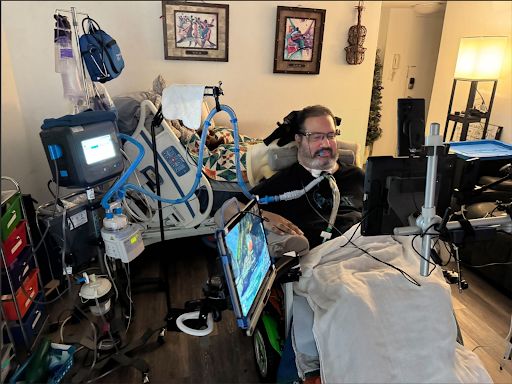
At his Washington, D.C., apartment, 54-year-old Will Greenfield, who is living with ALS, is surrounded by the medical and adaptive technology that sustains his care, communication, and independence.
Ice covers sidewalks and side streets across Washington, D.C., as the city prepares to enter February. Many residents are forced to stay inside while the federal government remains stuck in a partial shutdown. A partial federal government shutdown is in effect. At the same time, health care debates in Congress and rising insurance premiums are creating uncertainty and anxiety about the continuity of their essential care.
Inside his home, 54-year-old Will Greenfield moves carefully through his living room in a power wheelchair that costs more than most cars. He cannot lift his arms. He cannot scratch an itch. He cannot adjust his body when pain sets in. A ventilator helps him breathe every hour of the day.
But his mind is fully awake.
Greenfield has amyotrophic lateral sclerosis (ALS), a disease that slowly shuts down the body while leaving a person mentally aware. He has lived with it for 19 years, far longer than the typical two-to-five-year life expectancy reported by the National Institute of Neurological Disorders and Stroke.
“My body doesn’t work,” he said. “But everything inside my head still does.”
ALS has taken almost all of Greenfield’s physical abilities. He cannot walk, speak clearly, or move his limbs on his own. But he can feel everything: pain, pressure, heat, and cold.
“I wish I was paralyzed,” he said. “At least then I wouldn’t feel it.”
Greenfield’s symptoms began in his early 30s with weakness in his legs and frequent falls. Doctors first misdiagnosed him. It wasn’t until later that specialists confirmed ALS.
“It happens slowly,” he explained. “One month it’s your foot. Then your knee. Then your whole leg.”
Within three years, he needed a wheelchair. By his 40s, his arms weakened. Caregivers now stretch his body every four hours to prevent stiffness and pain.
“You stretched your fingers earlier without thinking,” he told me. “I can’t do that. Someone has to do it for me.”
In 2017, Greenfield experienced respiratory failure and fell into a coma for several days. When he woke up, his voice was weaker, and he feared losing it completely.
“My faith kept me talking,” he said.
Staying alive now requires constant medical care. Greenfield depends on skilled nurses, respiratory therapy, home health aides, ventilators, and adaptive equipment. The cost of that care is close to $900,000 a year, most of it covered by Medicaid.
Without that coverage, he says, he would not survive.
“I would die,” he said.
His wheelchair alone costs $145,000. His hospital bed, designed to prevent pressure sores, costs tens of thousands of dollars. He uses suction machines to clear his airway and relies on backup ventilators in case one fails.
This level of care is impossible for most people to afford on their own. Federal health data shows long-term care for medically complex patients can cost hundreds of thousands of dollars per year.
But right now, that support feels uncertain.
As February begins, debates over Medicaid and Medicare funding are still unresolved. At the same time, many Americans are facing higher insurance premiums and uncertainty about what coverage will look like in the coming year. Disability advocates warn that proposed Medicaid funding caps or cuts could reduce access to home-based care and force people with severe disabilities into nursing homes.
For Greenfield, that possibility is terrifying.
“If Medicaid is cut,” he said, “I’d be back in a nursing home. Or dead.”
He spent five years in a nursing facility earlier in his illness, including during the COVID-19 pandemic.
“There were two or three nurses for over 40 patients on ventilators,” he said. “That’s not care. That’s survival.”
Greenfield says lawmakers understand the consequences of their decisions.
“They know what they’re doing,” he said. “You can see it in the bills they write.”
Despite everything, Greenfield still finds joy in small moments. Bible study twice a week. Visits from friends. A good meal cooked by his caregiver.
“When Marie cooks, it’s a good day,” he said.
Bad days come when nurses cancel shifts, equipment fails, or he thinks about the life he once imagined.
Still, he stays involved in advocacy and policy conversations.
“I’m still here,” he said. “I still matter.”
As lawmakers argue over budgets and health care funding, Greenfield wants people to understand what these debates mean for people like him.
“Health care isn’t politics to us,” he said. “It’s life.”
Amyah Wright is a broadcast journalism major at Howard University. You can follow her on Instagram at @amywah.wright
SEE ALSO:
Principal Offers Refuge For Students Living With ICE Raids
Howard Students Still Facing Hunger After SNAP Disruptions
‘Trapped In A Body That Won’t Move’: 1 Man’s Fight To Live As Health Care Hangs In The Balance was originally published on newsone.com


